
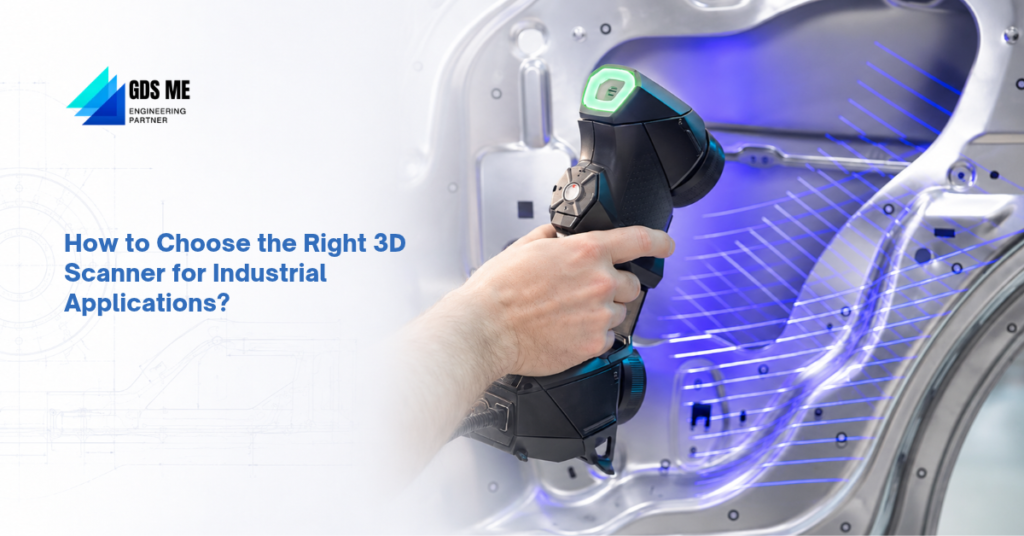
Are you planning to buy a 3D scanner for industrial purposes? Technology is so advanced that when you search for scanners, you come across a wide variety of options. You may feel confused about choosing the right industrial 3D scanner. With so many options, you may feel lost.
This blog addresses these concerns and guides you towards making the right choice.
Once you shortlist a scanner, another question is where to buy it. It is not a wise decision to get one from random manufacturers or suppliers. Generative Design Solutions Middle East is an authorized reseller of Creaform 3D scanners in the GCC region.
Of course, there are a few things you should check before making the final decision, such as whether the scanner can handle your largest components, whether its accuracy meets your requirements, and whether it suits the way your team works.
Key Factors to Consider When Choosing an Industrial 3D Scanner
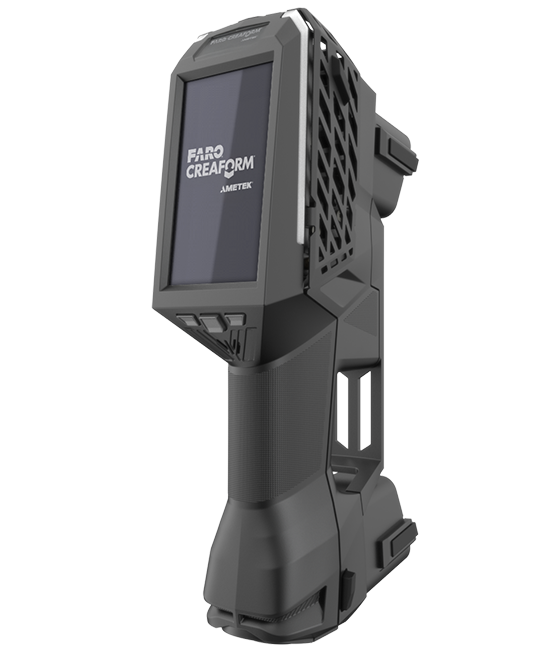
credit – https://www.creaform3d.com/en/products/portable-3d-scanners/handyscan-3d-evo-series
So, how can you choose the best industrial 3D scanner? Here are a few ideas. Go through each of them so that you can easily narrow down the options and pick the right scanner for your industrial needs.
- Scanning Accuracy – How accurate should your 3D scanner be? Well, that depends on what you are planning to do with it. If you are using it to inspect machine parts or automotive components, you need to make sure the scanner captures the measurements correctly. Even a small difference matters in some situations. So, before choosing a model, check its accuracy level and see whether it meets your requirements.
- Resolution – What if you need to scan components with tiny holes, fine edges or complicated shapes? You need a scanner that can capture these details properly. This is where resolution comes into the picture. It determines how much detail the scanner can capture from the surface. So, don’t just look at accuracy when comparing different 3D scanners. Resolution matters too.
- Scanning Speed – Scanning speed is one of the most important factors when choosing a 3D scanner. How fast does your scanner work? You can find high-speed, accurate 3D scanners for industrial applications. But the right choice depends on what you need the scanner for. The key is to understand your requirements and ensure the scanning speed meets your industrial demands without compromising accuracy.
- Scanning volume – Are you an oil and gas pipeline maintenance company in Abu Dhabi? Then you need to scan large industrial equipment. Scanning volume determines how much of an object the 3D scanner can capture in one scan frame. Analyze your needs and choose a scanner that meets them.
- Surface Compatibility – Not all industrial components have the same surface. Some may be shiny, dark, or even transparent. These surfaces can be difficult to scan, and the results may vary depending on the 3D scanner you use. So, if you regularly work with different materials, make sure the scanner suits them.
- Portability – Do you need to scan components at different locations? You can carry a handheld 3D scanner makes this easier. Take it around the factory or take it to large equipment that cannot be moved. Stationary scanners are more suitable when you have a dedicated space for scanning. So, think about where you will be using the scanner before choosing a model.
- Ease of Use – How easy is the 3D scanner to operate? Your team should be able to use it without too much difficulty. 3D scanners come with impressive features like markerless AI tracking, anti-shake technology, simple guided software, and more! Training and technical support are also important, particularly when your team is new to 3D scanning.
Matching 3D Scanner Capabilities with Industrial Requirements
You get a variety of 3D scanners in the market. Choosing the right 3D scanner means finding one that suits your requirements. Here are a few things to consider.
- Small, intricate components: Are you handling small components with tiny holes, fine edges and intricate details? Go for a high-resolution 3D scanner that can capture these features properly.
- Large industrial structures: Scanning pipelines, heavy machinery and large equipment requires a scanner with a suitable scanning range. This helps capture larger areas with fewer scan positions.
- Complex geometries and freeform surfaces: Working with curved surfaces, irregular shapes or deep recesses is a quite different case. You have to buy a scanner that can capture these details properly.
- High-Precision Dimensional Inspection: Is manufactured parts meeting exact dimensions a pressing need for your company? You need a 3D scanner with high accuracy to measure components and identify even small variations.
- Production Line Quality Control: Do you handle regular quality checks in your manufacturing unit? A fast 3D scanner helps inspect more components in less time and keeps the production process moving.
Industry-Specific Applications of 3D Scanners
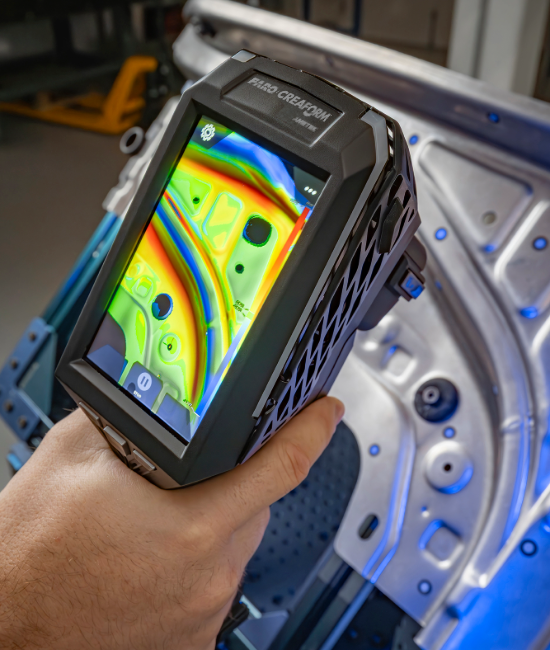
credit – https://www.creaform3d.com/en/products/portable-3d-scanners/handyscan-3d-evo-series
To help readers choose the right scanner, we would like to talk about a few common industries as well. We cover all the key aspects so you can narrow down your needs and choose the right scanner for your industry.
- Automotive: Are you working with car parts? 3D scanning helps check whether the components match the required dimensions and identify design issues. It also makes it easier to recreate existing parts or develop custom components.
- Manufacturing: You need to make sure the finished products match the original design. 3D scanning helps measure components quickly. It is also useful when developing prototypes, as you can turn an existing physical object into a digital model.
- Heavy Engineering: Do you work with large machines or industrial structures? You may not be able to dismantle them just for inspection. 3D scanning helps capture their dimensions and identify wear, misalignment, or deformation.
- Medical Device Manufacturing: Medical components often have very small features where accuracy matters. A 3D scanner helps capture these details. It is also useful for developing custom-fit implants and prosthetics.
- Tool and Die Manufacturing: Molds and dies can develop wear after regular use. 3D scanning helps inspect their surfaces and identify defects. You can also use it to recreate old tools when the original CAD design is no longer available.
Common Mistakes to Avoid When Buying an Industrial 3D Scanner
- Deciding based on the price tag alone
- Lack of proper comparison between features and demands
- Assuming one scanner can handle all types of surfaces? Check its compatibility first.
- Forgot to check software compatibility? Make sure it works with your existing systems.
- Choosing a scanner without thinking about your actual scanning needs? Don’t get carried away by fancy features.
Generative Design Solutions Middle East: Your Trusted 3D Scanning Partner in the GCC
Generative Design Solutions Middle East has been stamping its expertise in providing quality engineering solutions to companies from various domains in the Middle East. We are an authorized reseller of Creaform 3D scanners in the GCC region, offering different portable 3D scanning solutions, including the HandySCAN 3D series.
Are you looking for a scanner for inspection, reverse engineering or other industrial applications? We can help you find one that suits your needs. We also provide sales and technical support across GCC countries.
Why Choose GDS Middle East?
- Authorized Creaform reseller: You can get genuine Creaform 3D scanning solutions through an authorized reseller in the GCC region.
- Different scanner options: We offer portable 3D scanners, including the HandySCAN 3D series. You can explore different models based on your scanning requirements.
- Help with scanner selection: Not sure which scanner to choose? Tell us about your applications and the components you need to scan. We can help you find a suitable option.
- Sales and technical support: Our support team is available across GCC countries to help you with your 3D scanning requirements.
- Regional expertise: We serve customers in the UAE, Saudi Arabia, Oman, Qatar and Kuwait with quality engineering solutions. Having a widespread market makes us the experts in what we do.
FAQs
A. Are you into scanning every day? Think whether accuracy helps or not! Professional scanners are the best investment for your company.
A. Not always. Talk to an authorized reseller about your multiple needs. They can help you find the right scanner.
A. Not always. But training and technical support are always an add-on when you buy 3D scanners.
A. Yes! You can scan the existing component and use the captured data to create a digital 3D model.
So, like any other product, analyze your needs thoroughly and compare them with the product specifications to choose the best 3D scanner for your industry. Authorized resellers can help you beyond a simple guidance. Sales and technical support, along with regional expertise, matter when choosing where to buy. GDSME can help you choose the best 3d scanner for your industrial needs.